找化学品上960化工网!
| 供应商 | 上海联迈生物工程有限公司 |
| 数量 | 大量 |
| 目录编号 | LM-7478R |
| 克隆性 | 多克隆 |
| 抗原来源 | Rabbit |
| 保质期 | 1年 |
| 抗体英文名 | PKN1 |
| 抗体名 | 蛋白激酶C相关激酶1抗体 |
| 宿主 | Rabbit |
| 适应物种 | Human, Mouse, Rat, Dog, Cow, |
| 免疫原 | KLH conjugated synthetic peptide derived from human PKN1:201-300/942 |
| 亚型 | IgG |
| 形态 | Lyophilized or Liquid |
| 应用范围 | ELISA=1:500-1000 IHC-P=1:400-800 IHC-F=1:400-800 ICC=1:100-500 IF=1:100-500 (石蜡切片需做抗原修复) |
| 浓度 | 1mg/ml |
| 保存条件 | Store at -20 °C |
| 规格 | 100ul 200ul |
| 英文名称 | PKN1 |
| 中文名称 | 蛋白激酶C相关激酶1抗体 |
| 别 名 | DBK; PAK 1; PAK-1; PAK1; PKC1; PKN ALPHA; PKN; Pkn1; PKN1_HUMAN; PRK1; PRKCL1; Protease activated kinase 1; Protease-activated kinase 1; Protein kinase C like 1; Protein kinase C like PKN; Protein kinase C related kinase 1; Protein kinase C-like 1; Protein kinase C-like PKN; Protein kinase N1; Protein kinase PKN alpha; Protein kinase PKN-alpha; Protein-kinase C-related kinase 1; Serine threonine kinase N; Serine threonine protein kinase N; Serine-threonine protein kinase N; Serine/threonine protein kinase N1; Serine/threonine-protein kinase N1. |
| 规格价格 | 100ul/1380元 购买 200ul/2200元 购买 大包装/询价 |
| 说 明 书 | 100ul 200ul |
| 研究领域 | 细胞生物 信号转导 激酶和磷酸酶 表观遗传学 |
| 抗体来源 | Rabbit |
| 克隆类型 | Polyclonal |
| 交叉反应 | Human, Mouse, Rat, Dog, Cow, |
| 产品应用 | ELISA=1:500-1000 IHC-P=1:400-800 IHC-F=1:400-800 ICC=1:100-500 IF=1:100-500 (石蜡切片需做抗原修复) not yet tested in other applications. optimal dilutions/concentrations should be determined by the end user. |
| 分 子 量 | 104kDa |
| 细胞定位 | 细胞核 细胞浆 |
| 性 状 | Lyophilized or Liquid |
| 浓 度 | 1mg/ml |
| 免 疫 原 | KLH conjugated synthetic peptide derived from human PKN1:201-300/942 |
| 亚 型 | IgG |
| 纯化方法 | affinity purified by Protein A |
| 储 存 液 | 0.01M TBS(pH7.4) with 1% BSA, 0.03% Proclin300 and 50% Glycerol. |
| 保存条件 | Store at -20 °C for one year. Avoid repeated freeze/thaw cycles. The lyophilized antibody is stable at room temperature for at least one month and for greater than a year when kept at -20°C. When reconstituted in sterile pH 7.4 0.01M PBS or diluent of antibody the antibody is stable for at least two weeks at 2-4 °C. |
| PubMed | PubMed |
| 产品介绍 | background: The protein encoded by this gene belongs to the protein kinase C superfamily. This kinase is activated by Rho family of small G proteins and may mediate the Rho-dependent signaling pathway. This kinase can be activated by phospholipids and by limited proteolysis. The 3-phosphoinositide dependent protein kinase-1 (PDPK1/PDK1) is reported to phosphorylate this kinase, which may mediate insulin signals to the actin cytoskeleton. The proteolytic activation of this kinase by caspase-3 or related proteases during apoptosis suggests its role in signal transduction related to apoptosis. Alternatively spliced transcript variants encoding distinct isoforms have been observed. [provided by RefSeq, Jul 2008] Function: PKC-related serine/threonine-protein kinase involved in various processes such as regulation of the intermediate filaments of the actin cytoskeleton, cell migration, tumor cell invasion and transcription regulation. Regulates the cytoskeletal network by phosphorylating proteins such as VIM and neurofilament proteins NEFH, NEFL and NEFM, leading to inhibit their polymerization. Phosphorylates 'Ser-575', 'Ser-637' and 'Ser-669' of MAPT/Tau, lowering its ability to bind to microtubules, resulting in disruption of tubulin assembly. Acts as a key coactivator of androgen receptor (ANDR)-dependent transcription, by being recruited to ANDR target genes and specifically mediating phosphorylation of 'Thr-11' of histone H3 (H3T11ph), a specific tag for epigenetic transcriptional activation that promotes demethylation of histone H3 'Lys-9' (H3K9me) by KDM4C/JMJD2C. Phosphorylates HDAC5, HDAC7 and HDAC9, leading to impair their import in the nucleus. Phosphorylates 'Thr-38' of PPP1R14A, 'Ser-159', 'Ser-163' and 'Ser-170' of MARCKS, and GFAP. Able to phosphorylate RPS6 in vitro. Subcellular Location: Cytoplasm. Nucleus. Endosome. Cell membrane. Cleavage furrow. Midbody. Associates with chromatin in a ligand-dependent manner. Localization to endosomes is mediated via its interaction with RHOB. Association to the cell membrane is dependent on Ser-374 phosphorylation. Accumulates during telophase at the cleavage furrow and finally concentrates around the midbody in cytokinesis. Tissue Specificity: Found ubiquitously. Expressed in heart, brain, placenta, lung, skeletal muscle, kidney and pancreas. Expressed in numerous tumor cell lines, especially in breast tumor cells. Post-translational modifications: Autophosphorylated; preferably on serine. Phosphorylated during mitosis. Activated by limited proteolysis with trypsin. Similarity: Belongs to the protein kinase superfamily. AGC Ser/Thr protein kinase family. PKC subfamily. Contains 1 AGC-kinase C-terminal domain. Contains 1 C2 domain. Contains 1 protein kinase domain. Contains 3 REM (Hr1) repeats. SWISS: Q16512 Gene ID: 5585 Database links: Entrez Gene: 5585 Human Entrez Gene: 320795 Mouse Entrez Gene: 29355 Rat Omim: 601032 Human SwissProt: Q16512 Human SwissProt: P70268 Mouse SwissProt: Q63433 Rat Unigene: 466044 Human Unigene: 213000 Mouse Unigene: 49880 Rat Important Note: This product as supplied is intended for research use only, not for use in human, therapeutic or diagnostic applications. |
| 产品图片 | 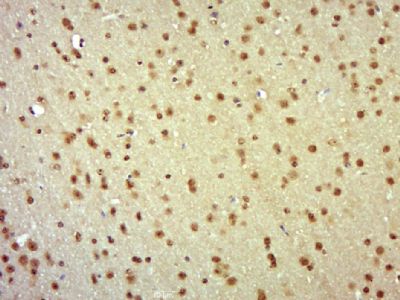 Paraformaldehyde-fixed, paraffin embedded (Mouse brain); Antigen retrieval by boiling in sodium citrate buffer (pH6.0) for 15min; Block endogenous peroxidase by 3% hydrogen peroxide for 20 minutes; Blocking buffer (normal goat serum) at 37°C for 30min; Antibody incubation with (PKN1) Polyclonal Antibody, Unconjugated (bs-7478R) at 1:500 overnight at 4°C, followed by a conjugated secondary (sp-0023) for 20 minutes and DAB staining. |








