| 供应商 | 上海联迈生物工程有限公司 |
| 数量 | 大量 |
| 目录编号 | LM-2514R |
| 克隆性 | 多克隆 |
| 抗原来源 | Rabbit |
| 保质期 | 1年 |
| 抗体英文名 | CCR5 |
| 抗体名 | 细胞表面趋化因子受体5抗体 |
| 宿主 | Rabbit |
| 适应物种 | Human, Mouse, Rat, |
| 免疫原 | KLH conjugated synthetic peptide derived from human CCR-5:201-300/352 <Cytoplasmic> |
| 亚型 | IgG |
| 形态 | Lyophilized or Liquid |
| 应用范围 | WB=1:500-2000 ELISA=1:500-1000 IHC-P=1:400-800 IHC-F=1:400-800 Flow-Cyt=1μg/Test IF=1:100-500 (石蜡切片需做抗原修复) |
| 浓度 | 1mg/ml |
| 保存条件 | Store at -20 °C |
| 规格 | 50ul 100ul 200ul |
| 英文名称 | CCR5 |
| 中文名称 | 细胞表面趋化因子受体5抗体 |
| 别 名 | C-C chemokine receptor 5; CCR5; CC-CKR-5;CCR-5; CCCKR5; CD195; CD 195; CKR-5; CKR5; CMKBR5; FLJ78003; IDDM22; AM4-7; C C chemokine receptor type 5; C-C motif chemokine receptor 5 A159A; CC Chemokine Receptor Type 5; CCR5 chemokine (C C motif) receptor 5; Chemokine receptor CCR5; CHEMR13; HIV 1 Fusion Coreceptor; HIV1 fusion coreceptor; IDDM22; MIP-1 alpha receptor; CCR5_HUMAN. |
 | Specific References (1) | bs-2514R has been referenced in 1 publications. [IF=3.73] Ochoa-Callejero, Laura, et al. "Maraviroc, a CCR5 Antagonist, Prevents Development of Hepatocellular Carcinoma in a Mouse Model." PloS one 8.1 (2013): e53992. IHC-P ; Mouse. PubMed:23326556 |
| 规格价格 | 50ul/780元 购买 100ul/1380元 购买 200ul/2200元 购买 大包装/询价 |
| 说 明 书 | 50ul 100ul 200ul |
| 研究领域 | 细胞生物 免疫学 细胞膜受体 细胞表面分子 |
| 抗体来源 | Rabbit |
| 克隆类型 | Polyclonal |
| 交叉反应 | Human, Mouse, Rat, |
| 产品应用 | WB=1:500-2000 ELISA=1:500-1000 IHC-P=1:400-800 IHC-F=1:400-800 Flow-Cyt=1μg/Test IF=1:100-500 (石蜡切片需做抗原修复) not yet tested in other applications. optimal dilutions/concentrations should be determined by the end user. |
| 分 子 量 | 40kDa |
| 细胞定位 | 细胞膜 |
| 性 状 | Lyophilized or Liquid |
| 浓 度 | 1mg/ml |
| 免 疫 原 | KLH conjugated synthetic peptide derived from human CCR-5:201-300/352 <Cytoplasmic> |
| 亚 型 | IgG |
| 纯化方法 | affinity purified by Protein A |
| 储 存 液 | 0.01M TBS(pH7.4) with 1% BSA, 0.03% Proclin300 and 50% Glycerol. |
| 保存条件 | Store at -20 °C for one year. Avoid repeated freeze/thaw cycles. The lyophilized antibody is stable at room temperature for at least one month and for greater than a year when kept at -20°C. When reconstituted in sterile pH 7.4 0.01M PBS or diluent of antibody the antibody is stable for at least two weeks at 2-4 °C. |
| PubMed | PubMed |
| 产品介绍 | background: This gene encodes a member of the beta chemokine receptor family, which is predicted to be a seven transmembrane protein similar to G protein-coupled receptors. This protein is expressed by T cells and macrophages, and is known to be an important co-receptor for macrophage-tropic virus, including HIV, to enter host cells. Defective alleles of this gene have been associated with the HIV infection resistance. The ligands of this receptor include monocyte chemoattractant protein 2 (MCP-2), macrophage inflammatory protein 1 alpha (MIP-1 alpha), macrophage inflammatory protein 1 beta (MIP-1 beta) and regulated on activation normal T expressed and secreted protein (RANTES). Expression of this gene was also detected in a promyeloblastic cell line, suggesting that this protein may play a role in granulocyte lineage proliferation and differentiation. This gene is located at the chemokine receptor gene cluster region. Two transcript variants encoding the same protein have been found for this gene. [provided by RefSeq]. Function: Receptor for a number of inflammatory CC-chemokines including MIP-1-alpha, MIP-1-beta and RANTES and subsequently transduces a signal by increasing the intracellular calcium ion level. May play a role in the control of granulocytic lineage proliferation or differentiation. Acts as a coreceptor (CD4 being the primary receptor) for HIV-1 R5 isolates. Subunit: Interacts with PRAF2. Interacts with HIV-1 surface protein gp120. Efficient ligand binding to CCL3/MIP-1alpha and CCL4/MIP-1beta requires sulfation, O-glycosylation and sialic acid modifications. Glycosylation on Ser-6 is required for efficient binding of CCL4. Interacts with ADRBK1. Interacts with ARRB1 and ARRB2. Interacts with human cytomegalovirus/HHV-5 protein UL78. Subcellular Location: Cell membrane; Multi-pass membrane protein. Tissue Specificity: Highly expressed in spleen, thymus, in the myeloid cell line THP-1, in the promyeloblastic cell line KG-1A and on CD4+ and CD8+ T-cells. Medium levels in peripheral blood leukocytes and in small intestine. Low levels in ovary and lung. Similarity: Belongs to the G-protein coupled receptor 1 family. SWISS: P51681 Gene ID: 1234 Database links: Entrez Gene: 1234 Human Entrez Gene: 12774 Mouse Entrez Gene: 117029 Rat Omim: 601373 Human SwissProt: P51681 Human SwissProt: P51682 Mouse SwissProt: O08556 Rat Unigene: 450802 Human Important Note: This product as supplied is intended for research use only, not for use in human, therapeutic or diagnostic applications. |
| 产品图片 | 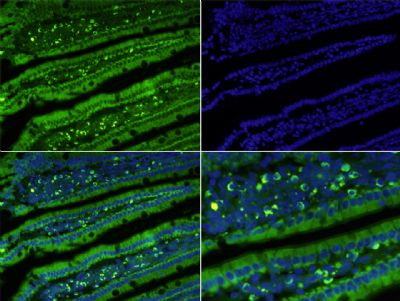 Tissue/cell: mouse intestinal tissue;4% Paraformaldehyde-fixed and paraffin-embedded; Antigen retrieval: citrate buffer ( 0.01M, pH 6.0 ), Boiling bathing for 15min; Blocking buffer (normal goat serum,C-0005) at 37℃ for 20 min; Incubation: Anti-CCR5 Polyclonal Antibody, Unconjugated(bs-2514R-FITC) 1:100, overnight at 4°C; DAPI(5ug/ml,blue,C-0033) was used to stain the cell nuclei 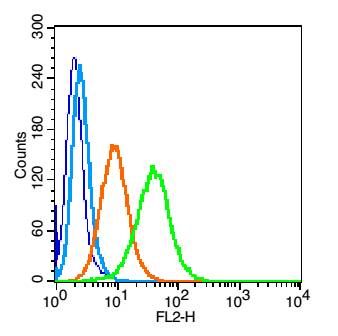 Blank control(blue): U937(fixed with 2% paraformaldehyde (10 min)) . Primary Antibody:Rabbit Anti-CCR5 antibody(bs-2514R), Dilution: 1μg in 100 μL 1X PBS containing 0.5% BSA; Isotype Control Antibody: Rabbit IgG(orange) ,used under the same conditions ); Secondary Antibody: Goat anti-rabbit IgG-PE(white blue), Dilution: 1:200 in 1 X PBS containing 0.5% BSA. |





