英文名称TLR4
中文名称
Toll样受体4抗体别 名TLR4; TLR-4; TLR 4; ARMD10; CD 284; CD284; CD284 antigen; Homolog of Drosophila toll; hTol; Toll (Drosophila) homolog; TOLL; Toll Endotoxin Hyporesponsiveness; Toll like receptor 4; Toll like receptor 4 precursor; TLR4_HUMAN.
规格50ul 100ul 200ul
研究领域心血管 免疫学 信号转导 细胞膜受体
抗体来源Rabbit
克隆类型Polyclonal
交叉反应 Human, Mouse, Rat, Pig, Cow, Horse, Rabbit, Sheep,
产品应用WB=1:1000-2000 ELISA=1:1000-5000 IHC-P=1:500-1000 IHC-F=1:500-1000 ICC=1:100-500 IF=1:200-1000 (石蜡切片需做抗原修复)
not yet tested in other applications.
optimal dilutions/concentrations should be determined by the end user.
分 子 量90kDa
细胞定位细胞膜
性 状Lyophilized or Liquid
浓 度1mg/ml
免 疫 原KLH conjugated synthetic peptide derived from human TLR4:701-800/839
亚 型IgG
纯化方法affinity purified by Protein A
储 存 液0.01M TBS(pH7.4) with 1% BSA, 0.03% Proclin300 and 50% Glycerol.
保存条件Store at -20 °C for one year. Avoid repeated freeze/thaw cycles. The lyophilized antibody is stable at room temperature for at least one month and for greater than a year when kept at -20°C. When reconstituted in sterile pH 7.4 0.01M PBS or diluent of antibody the antibody is stable for at least two weeks at 2-4 °C.
PubMedPubMed
产品介绍background:
The Toll-like receptor 4 by activating natural immunity, specific immune response involved in the start-up, Toll-like receptor 4 as an important signal transduction transmembrane receptor involved in the toxin-induced inflammation in the pathological process, its mechanisms of control On a growing concern. all regions were either double-stranded or sequenced with an alternatechemistry or covered by high quality data(i.e., phred quality >=30); an attempt was made to resolve all sequencing problems, such as compressions and repeats; all regions were covered by at least one subclone; and the assembly was confirmed by restriction digest, except on the rare occasion of the clone being a YAC. The following abbreviations are used to associate primary accession numbers given in the feature table with their source databases: Em:, EMBL; Sw:, SWISSPROT; Tr:, TREMBL; Wp:, WORMPEP; Information on the WORMPEP database can be found at. TLR-4 plays an important role in microvascular leakage and leukocyte adhesion under the inflammatory condition associated with nonseptic thermal injury.
Function:
Cooperates with LY96 and CD14 to mediate the innate immune response to bacterial lipopolysaccharide (LPS). Acts via MYD88, TIRAP and TRAF6, leading to NF-kappa-B activation, cytokine secretion and the inflammatory response. Also involved in LPS-independent inflammatory responses triggered by Ni(2+). These responses require non-conserved histidines and are, therefore, species-specific.
Subcellular Location:
Membrane; Single-pass type I membrane protein.
Tissue Specificity:
Highly expressed in placenta, spleen and peripheral blood leukocytes. Detected in monocytes, macrophages, dendritic cells and several types of T-cells.
Post-translational modifications:
N-glycosylated. Glycosylation of Asn-526 and Asn-575 seems to be necessary for the expression of TLR4 on the cell surface and the LPS-response. Likewise, mutants lacking two or more of the other N-glycosylation sites were deficient in interaction with LPS.
DISEASE:
Genetic variation in TLR4 is associated with age-related macular degeneration type 10 (ARMD10) [MIM:611488]. ARMD is a multifactorial eye disease and the most common cause of irreversible vision loss in the developed world. In most patients, the disease is manifest as ophthalmoscopically visible yellowish accumulations of protein and lipid that lie beneath the retinal pigment epithelium and within an elastin-containing structure known as Bruch membrane.
Similarity:
Belongs to the Toll-like receptor family.
Contains 18 LRR (leucine-rich) repeats.
Contains 1 LRRCT domain.
Contains 1 TIR domain
SWISS:
O00206
Gene ID:
7099
Database links:
Entrez Gene: 7099 Human
Entrez Gene: 21898 Mouse
Entrez Gene: 29260 Rat
SwissProt: O00206 Human
SwissProt: Q9QUK6 Mouse
SwissProt: Q9QX05 Rat
Unigene: 174312 Human
Unigene: 38049 Mouse
Important Note:
This product as supplied is intended for research use only, not for use in human, therapeutic or diagnostic applications.
| 产品图片 | 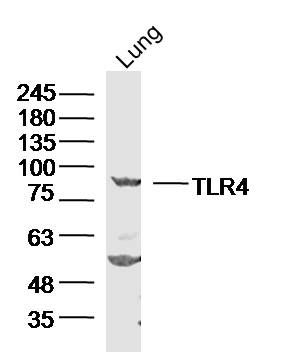
Sample:
Lung(Mouse) Lysate at 40 ug
Primary: Anti- TLR4 (bs-20594R) at 1/300 dilution
Secondary: IRDye800CW Goat Anti-Rabbit IgG at 1/20000 dilution
Predicted band size: 90 kD
Observed band size: 90 kD
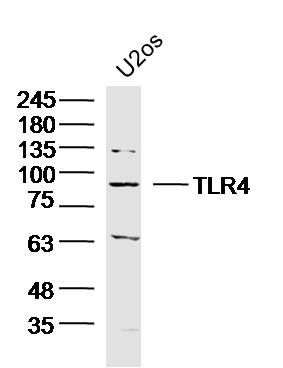
Sample:
U2OS(Human) Lysate at 30 ug
Primary: Anti- TLR4 (bs-20594R) at 1/300 dilution
Secondary: IRDye800CW Goat Anti-Rabbit IgG at 1/20000 dilution
Predicted band size: 90 kD
Observed band size: 90 kD
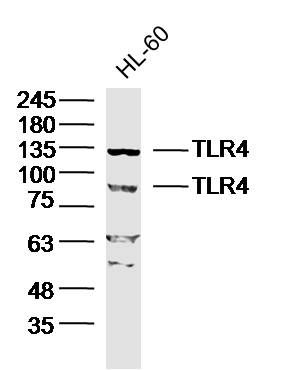
Sample:
HL60 (Human) Lysate at 30 ug
Primary: Anti- TLR4 (bs-20594R) at 1/300 dilution
Secondary: IRDye800CW Goat Anti-Rabbit IgG at 1/20000 dilution
Predicted band size: 90 kD
Observed band size: 90 kD
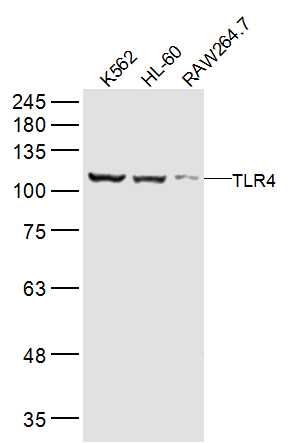
Sample:
K562(Human) Cell Lysate at 40 ug
HL-60(Human) Cell Lysate at 40 ug
RAW264.7(Mouse) Cell Lysate at 40 ug
Primary:Anti-TLR4 (bs-20594R) at 1/2000 dilution
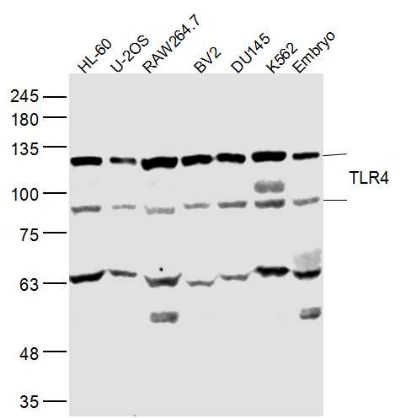
Sample:
HL-60(Human) Cell Lysate at 40 ug
U-2OS(Human) Cell Lysate at 40 ug
RAW264.7(Mouse) Cell Lysate at 40 ug
BV2(Mouse) Cell Lysate at 40 ug
DU145(Human) Cell Lysate at 40 ug
K562(Human) Cell Lysate at 40 ug
Embryo (Mouse) Lysate at 40 ug
Primary: Anti-TLR4 (bs-20594R) at 1/300 dilution
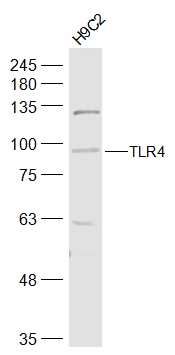
Sample:
H9C2(Rat) Cell Lysate at 30 ug
Primary: Anti-TLR4 (bs-20594R) at 1/300 dilution
Secondary: IRDye800CW Goat Anti-Rabbit IgG at 1/20000 dilution
Predicted band size: 90 kD
Observed band size: 90 kD
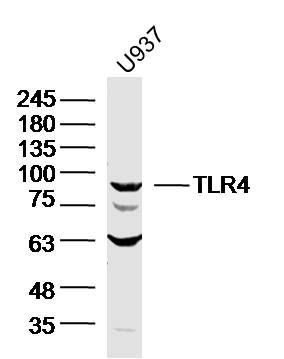
Sample:
U937 (Human) Lysate at 30 ug
Primary: Anti- TLR4 (bs-20594R) at 1/300 dilution
Secondary: IRDye800CW Goat Anti-Rabbit IgG at 1/20000 dilution
Predicted band size: 90 kD
Observed band size: 90 kD
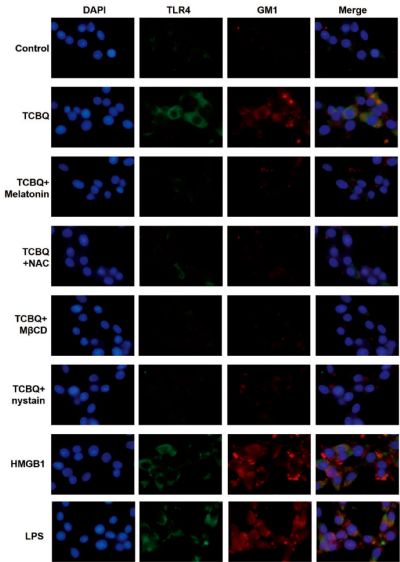
This image was generously provided by Juanli Fu, at Southwest University in Chong Qing, China. 4% Paraformaldehyde fixed PC12 cells stained with Rabbit Anti- TLR4 Polyclonal Antibody (bs-20594R) at 1:300 for 3 hours at 4°C, followed by Alexa Fluor 488-conjugated secondary antibody for an additional hour. |








