| 供应商 | 上海联迈生物工程有限公司 |
| 数量 | 大量 |
| 目录编号 | LM-0829R |
| 克隆性 | 多克隆 |
| 抗原来源 | Rabbit |
| 保质期 | 1年 |
| 抗体英文名 | Nanog |
| 抗体名 | 胚胎干细胞关键蛋白抗体 |
| 宿主 | Rabbit |
| 适应物种 | Mouse, Rat, Pig, |
| 免疫原 | KLH conjugated synthetic peptide derived from mouse Nanog:71-170/305 |
| 亚型 | IgG |
| 形态 | Lyophilized or Liquid |
| 应用范围 | WB=1:500-2000 ELISA=1:500-1000 IHC-P=1:400-800 IHC-F=1:400-800 Flow-Cyt=3μg/Test IF=1:100-500 (石蜡切片需做抗原修复) |
| 浓度 | 1mg/ml |
| 保存条件 | Store at -20 °C |
| 规格 | 50ul 100ul 200ul |
| 英文名称 | Nanog |
| 中文名称 | 胚胎干细胞关键蛋白抗体 |
| 别 名 | NANOG_MOUSE; Embryonic stem cell specific homeobox protein (Nanog); ENK; FLJ12581; FLJ40451; Homeobox transcription factor Nanog; Nanog homeobox; Homeobox protein NANOG; ES cell-associated protein 4; Early embryo specific expression NK-type homeobox protein; Homeobox transcription factor Nanog; Nanog; Ecat4. |
 | Specific References (2) | bs-0829R has been referenced in 2 publications. [IF=0.00] El-Badawy, Ahmed, et al. "Ovarian Extract Promotes Proliferation and Upregulates Pluripotency of Mesenchymal Stromal Cells." Journal of Ecology of Health & Environment (2016). IF(ICC) ; Mouse. PubMed:0 [IF=2.15] Liu, Yu-Hong, et al. "A signature for induced pluripotent stem cell–associated genes in colorectal cancer." Medical Oncology 30.1 (2013): 1-11. WB ; Human. PubMed:23307247 |
| 规格价格 | 50ul/780元 购买 100ul/1380元 购买 200ul/2200元 购买 大包装/询价 |
| 说 明 书 | 50ul 100ul 200ul |
| 研究领域 | 肿瘤 染色质和核信号 信号转导 干细胞 细胞周期蛋白 细胞表面分子 细胞分化 |
| 抗体来源 | Rabbit |
| 克隆类型 | Polyclonal |
| 交叉反应 | Mouse, Rat, Pig, |
| 产品应用 | WB=1:500-2000 ELISA=1:500-1000 IHC-P=1:400-800 IHC-F=1:400-800 Flow-Cyt=3μg/Test IF=1:100-500 (石蜡切片需做抗原修复) not yet tested in other applications. optimal dilutions/concentrations should be determined by the end user. |
| 分 子 量 | 34kDa |
| 细胞定位 | 细胞核 |
| 性 状 | Lyophilized or Liquid |
| 浓 度 | 1mg/ml |
| 免 疫 原 | KLH conjugated synthetic peptide derived from mouse Nanog:71-170/305 |
| 亚 型 | IgG |
| 纯化方法 | affinity purified by Protein A |
| 储 存 液 | 0.01M TBS(pH7.4) with 1% BSA, 0.03% Proclin300 and 50% Glycerol. |
| 保存条件 | Store at -20 °C for one year. Avoid repeated freeze/thaw cycles. The lyophilized antibody is stable at room temperature for at least one month and for greater than a year when kept at -20°C. When reconstituted in sterile pH 7.4 0.01M PBS or diluent of antibody the antibody is stable for at least two weeks at 2-4 °C. |
| PubMed | PubMed |
| 产品介绍 | background: Nanog is a newly identified homeodomain-bearing transcriptional factor. Nanog expression is specific to early embryos and pluripotential stem cells including mouse and human embryonic stem (ES) and embryonic germ (EG) cells. It is a key molecule involved in the signaling pathway for maintaining the capacity for self-renewal and pluripotency, bypassing regulation by the STAT3 pathway. Nanog mRNA is present in pluripotent mouse and human cell lines, and absent from differentiated cells. Nanog-deficient ES cells lose pluripotency and differentiate into extraembryonic endoderm lineage. Thus it is one of the molecular markers suitable for recognizing the undifferentiated state of stem cells in the mouse and human. NANOG is a new marker for testicular carcinoma in situ and germ cell tumors. NANOG is a gene expressed in embryonic stem cells (ESCs) and is thought to be a key factor in maintaining pluripotency. NANOG thought to function in concert with other factors such as POU5F1 and SOX2 to establish ESC identity. These cells offer an important area of study because of their ability to maintain pluripotency. In other words, these cells have the ability to become virtually any cell of any of the three germ layers (endoderm, ectoderm, mesoderm). Function: Transcription regulator involved in inner cell mass and embryonic stem (ES) cells proliferation and self-renewal. Imposes pluripotency on ES cells and prevents their differentiation towards extraembryonic endoderm and trophectoderm lineages. Blocks bone morphogenetic protein-induced mesoderm differentiation of ES cells by physically interacting with SMAD1 and interfering with the recruitment of coactivators to the active SMAD transcriptional complexes. Acts as a transcriptional activator or repressor. Binds optimally to the DNA consensus sequence 5'-TAAT[GT][GT]-3' or 5'-[CG][GA][CG]C[GC]ATTAN[GC]-3'. When overexpressed, promotes cells to enter into S phase and proliferation. Subunit: Interacts with SMAD1 and SALL4. Subcellular Location: Nucleus. Tissue Specificity: Expressed in testicular carcinoma and derived germ cell tumors (at protein level). Expressed in fetal gonads, ovary and testis. Also expressed in ovary teratocarcinoma cell line and testicular embryonic carcinoma. Not expressed in many somatic organs and oocytes. Similarity: Belongs to the Nanog homeobox family. Contains 1 homeobox DNA-binding domain. SWISS: Q80Z64 Gene ID: 71950 Database links: Entrez Gene: 100293888 Human Entrez Gene: 79923 Human Entrez Gene: 71950 Mouse Omim: 607937 Human SwissProt: Q9H9S0 Human Unigene: 635882 Human Important Note: This product as supplied is intended for research use only, not for use in human, therapeutic or diagnostic applications. 研究表明;早期胚胎在没有Nanog存在的情况下是不能存活的,但是这一蛋白的表达水平至今还有待于进一步研究。学者认为:Nanog依然是一种对于生殖细胞(germ lls)形成的必要因子,Nanog也是调控着细胞融合后的多重功能的关键因子。 胚胎干细胞是当今生命科学和生物技术研究的热点,这主要是由于其具有“发育全能性”的功能。ES能分化成人体200多种细胞类型,形成机体的任何细胞、组织和器官。通过掌握其分化发育的规律,在人工条件下定向分化为所需的细胞、组织乃至器官,科学家们希望可以用来治疗目前还难以或无法治愈的帕金森氏病、早老性痴呆、白血病、糖尿病等顽症,并且解决十分紧缺的组织和器官移植的来源问题,并且通过进一步与克隆技术相结合,运用体细胞核转移技术来得到ES,还能解决细胞治疗以及组织和器官移植的免疫排异难题。 |
| 产品图片 | 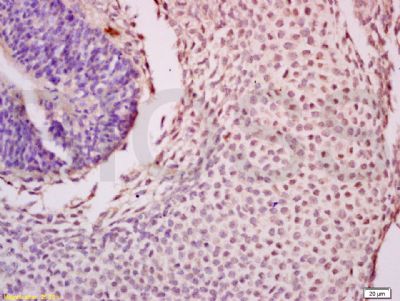 Tissue/cell: Mouse tooth germ tissue; 4% Paraformaldehyde-fixed and paraffin-embedded; Antigen retrieval: citrate buffer ( 0.01M, pH 6.0 ), Boiling bathing for 15min; Block endogenous peroxidase by 3% Hydrogen peroxide for 30min; Blocking buffer (normal goat serum,C-0005) at 37℃ for 20 min; Incubation: Anti-Nanog Polyclonal Antibody, Unconjugated(bs-0829R) 1:200, overnight at 4°C, followed by conjugation to the secondary antibody(SP-0023) and DAB(C-0010) staining  Blank control (blue line): Hela (blue). Primary Antibody (green line): Rabbit Anti-Nanog antibody(bs-0829R) Dilution: 1μg /10^6 cells; Isotype Control Antibody (orange line): Rabbit IgG . Secondary Antibody (white blue line): F(ab’)2 fragment goat anti-rabbit IgG-FITC Dilution: 1μg /test. Protocol The cells were fixed with 2% paraformaldehyde (10 min) , then permeabilized with 90% ice-cold methanol for 30 min on ice.Cells stained with Primary Antibody for 30 min at room temperature. The cells were then incubated in 1 X PBS/2%BSA/10% goat serum to block non-specific protein-protein interactions followed by the antibody for 15 min at room temperature. The secondary antibody used for 40 min at room temperature. Acquisition of 20,000 events was performed. |





