找化学品上960化工网!
| 供应商 | 上海联迈生物工程有限公司 |
| 数量 | 大量 |
| 目录编号 | LM-11608R |
| 克隆性 | 多克隆 |
| 抗原来源 | Rabbit |
| 保质期 | 1年 |
| 抗体英文名 | ZIC3 |
| 抗体名 | 内脏异位相关蛋白/锌指蛋白203抗体 |
| 宿主 | Rabbit |
| 适应物种 | Human, Mouse, Rat, Chicken, Dog, Pig, Cow, Sheep, |
| 免疫原 | KLH conjugated synthetic peptide derived from human ZIC3 (331-410aa):331-410/467 |
| 亚型 | IgG |
| 形态 | Lyophilized or Liquid |
| 应用范围 | WB=1:500-2000 ELISA=1:500-1000 IHC-P=1:400-800 IHC-F=1:400-800 ICC=1:100-500 IF=1:100-500 (石蜡切片需做抗原修复) |
| 浓度 | 1mg/ml |
| 保存条件 | Store at -20 °C |
| 规格 | 100ul 200ul |
| 英文名称 | ZIC3 |
| 中文名称 | 内脏异位相关蛋白/锌指蛋白203抗体 |
| 别 名 | Heterotaxy 1; HTX; HTX1; ZIC 3; Zic family member 3 (odd paired Drosophila homolog heterotaxy 1); Zic family member 3; Zic3; ZIC3_HUMAN; Zinc finger protein 203; Zinc finger protein of the cerebellum 3; Zinc finger protein ZIC 3 (Zinc finger protein of the cerebellum 3); Zinc finger protein ZIC 3; ZNF203. |
| 规格价格 | 100ul/1380元 购买 200ul/2200元 购买 大包装/询价 |
| 说 明 书 | 100ul 200ul |
| 研究领域 | 细胞生物 发育生物学 干细胞 转录调节因子 |
| 抗体来源 | Rabbit |
| 克隆类型 | Polyclonal |
| 交叉反应 | Human, Mouse, Rat, Chicken, Dog, Pig, Cow, Sheep, |
| 产品应用 | WB=1:500-2000 ELISA=1:500-1000 IHC-P=1:400-800 IHC-F=1:400-800 ICC=1:100-500 IF=1:100-500 (石蜡切片需做抗原修复) not yet tested in other applications. optimal dilutions/concentrations should be determined by the end user. |
| 分 子 量 | 51kDa |
| 细胞定位 | 细胞核 细胞浆 |
| 性 状 | Lyophilized or Liquid |
| 浓 度 | 1mg/ml |
| 免 疫 原 | KLH conjugated synthetic peptide derived from human ZIC3 (331-410aa):331-410/467 |
| 亚 型 | IgG |
| 纯化方法 | affinity purified by Protein A |
| 储 存 液 | 0.01M TBS(pH7.4) with 1% BSA, 0.03% Proclin300 and 50% Glycerol. |
| 保存条件 | Store at -20 °C for one year. Avoid repeated freeze/thaw cycles. The lyophilized antibody is stable at room temperature for at least one month and for greater than a year when kept at -20°C. When reconstituted in sterile pH 7.4 0.01M PBS or diluent of antibody the antibody is stable for at least two weeks at 2-4 °C. |
| PubMed | PubMed |
| 产品介绍 | background: Zic3 is a C2H2 zinc finger transcription factor that establishes a proper left-right axis and midline neural patterning during early development of the vertebrate embryo. Mutations in this gene cause X-linked visceral heterotaxy, which includes congenital heart disease and left-right axis defects in organs. Zic3 mutations in the zinc finger DNA binding domain and in the N-terminal domain result in loss of reporter gene transactivation, and mutations between amino acids 253-323 of the Zic3 protein causes aberrant cytoplasmic localization rather than the wild type nuclear localization. Function: Acts as transcriptional activator. Required in the earliest stages in both axial midline development and left-right (LR) asymmetry specification. Binds to the minimal GLI-consensus sequence 5'-GGGTGGTC-3'. Subcellular Location: Nucleus. Cytoplasm. Localizes in the cytoplasm in presence of MDFIC overexpression (By similarity). Translocation to the nucleus requires KPNA1 or KPNA6. DISEASE: Defects in ZIC3 are the cause of visceral heterotaxy X-linked type 1 (HTX1) [MIM:306955]. A form of visceral heterotaxy, a complex disorder due to disruption of the normal left-right asymmetry of the thoracoabdominal organs. It results in an abnormal arrangement of visceral organs, and a wide variety of congenital defects. Clinical features of visceral heterotaxy X-linked type 1 include dextrocardia, corrected transposition of great arteries, ventricular septal defect, patent ductus arteriosus, pulmonic stenosis, situs inversus viscerum, and asplenia and/or polysplenia. Defects in ZIC3 are a cause of VACTERL association X-linked with or without hydrocephalus (VACTERLX) [MIM:314390]. A syndrome characterized by vertebral anomalies, anal atresia, cardiac malformations, tracheoesophageal fistula, renal anomalies (urethral atresia with hydronephrosis), and limb anomalies (hexadactyly, humeral hypoplasia, radial aplasia, and proximally placed thumb). Some patients may have hydrocephalus. Some cases of VACTERL-H are associated with increased chromosome breakage and rearrangement. Similarity: Belongs to the GLI C2H2-type zinc-finger protein family. Contains 5 C2H2-type zinc fingers. SWISS: O60481 Gene ID: 7547 Database links: Entrez Gene: 7547 Human Entrez Gene: 22773 Mouse Entrez Gene: 367944 Rat Omim: 300265 Human SwissProt: O60481 Human SwissProt: Q62521 Mouse Unigene: 111227 Human Unigene: 255890 Mouse Important Note: This product as supplied is intended for research use only, not for use in human, therapeutic or diagnostic applications. |
| 产品图片 | 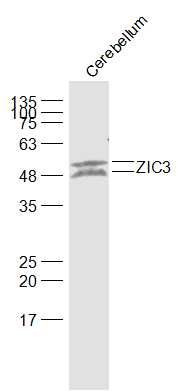 Sample: Cerebellum (Rat) Lysate at 40 ug Primary: Anti-ZIC3 (bs-11608R) at 1/1000 dilution Secondary: IRDye800CW Goat Anti-Rabbit IgG at 1/20000 dilution Predicted band size: 51 kD Observed band size: 49/50 kD 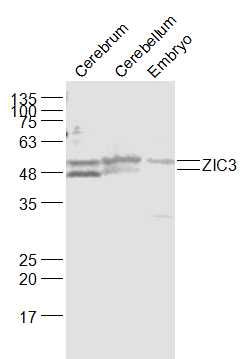 Sample: Cerebrum (Mouse) Lysate at 40 ug Cerebellum (Mouse) Lysate at 40 ug Embryo (Mouse) Lysate at 40 ug Primary: Anti-ZIC3 (bs-11608R) at 1/1000 dilution Secondary: IRDye800CW Goat Anti-Rabbit IgG at 1/20000 dilution Predicted band size: 51 kD Observed band size: 49/50 kD  Paraformaldehyde-fixed, paraffin embedded (Mouse brain); Antigen retrieval by boiling in sodium citrate buffer (pH6.0) for 15min; Block endogenous peroxidase by 3% hydrogen peroxide for 20 minutes; Blocking buffer (normal goat serum) at 37°C for 30min; Antibody incubation with (ZIC3) Polyclonal Antibody, Unconjugated (bs-11608R) at 1:400 overnight at 4°C, followed by operating according to SP Kit(Rabbit) (sp-0023) instructionsand DAB staining. 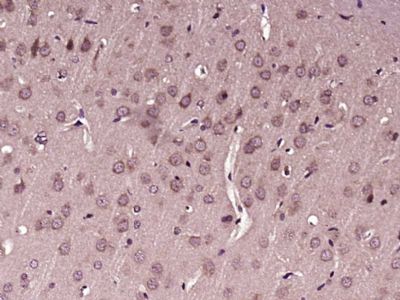 Paraformaldehyde-fixed, paraffin embedded (Rat brain); Antigen retrieval by boiling in sodium citrate buffer (pH6.0) for 15min; Block endogenous peroxidase by 3% hydrogen peroxide for 20 minutes; Blocking buffer (normal goat serum) at 37°C for 30min; Antibody incubation with (ZIC3) Polyclonal Antibody, Unconjugated (bs-11608R) at 1:400 overnight at 4°C, followed by operating according to SP Kit(Rabbit) (sp-0023) instructionsand DAB staining. |








