找化学品上960化工网!
| 供应商 | 上海康朗生物科技有限公司 |
| 数量 | 大量 |
| 目录编号 | kl-8869R |
| 克隆性 | 多克隆 |
| 抗原来源 | Rabbit |
| 保质期 | 12个月 |
| 抗体英文名 | IP3 receptor antibody |
| 抗体名 | 5-三磷酸肌醇受体1抗体 |
| 宿主 | Rabbit |
| 适应物种 | Human, Mouse, Rat, Chicken, Dog, Pig, Cow, Horse, Rabbit, Sheep, |
| 免疫原 | KLH conjugated synthetic peptide derived from human IP3R 1:101-200/2758 |
| 亚型 | IgG |
| 形态 | 冻干粉或液体 |
| 应用范围 | ELISA=1:500-1000 IHC-P=1:400-800 IHC-F=1:400-800 ICC=1:100-500 IF=1:100-500 |
| 浓度 | 1mg/ml |
| 保存条件 | -20 °C |
| 规格 | 100ul 200ul |
| 中文名称 | 5-三磷酸肌醇受体1抗体 |
| 别 名 | Type 1 inositol 1 4 5 trisphosphate receptor; Type 1 inositol 1; Type 1 InsP3 receptor.; 5-trisphosphate receptor; 5-trisphosphate receptor type 1; DKFZp313E1334; DKFZp313N1434; inositol 1 4 5 triphosphate receptor type 1; Inositol 1 4 5 trisphosphate Receptor Type 1; Inositol 1; Inositol 145-trisphosphate Receptor Type 1; InsP3R1; IP3; IP3 receptor; IP3 receptor isoform 1; IP3R 1; IP3R; IP3R1; ITPR 1; Itpr1; ITPR1_HUMAN; SCA15; SCA16; SCA29; ACV; CLA4; INSP3R1. |
| 规格价格 | 100ul/1380元 购买 200ul/2200元 购买 大包装/询价 |
| 说 明 书 | 100ul 200ul |
| 研究领域 | 肿瘤 细胞生物 信号转导 细胞凋亡 新陈代谢 |
| 抗体来源 | Rabbit |
| 克隆类型 | Polyclonal |
| 交叉反应 | Human, Mouse, Rat, Chicken, Dog, Pig, Cow, Horse, Rabbit, Sheep, |
| 产品应用 | ELISA=1:500-1000 IHC-P=1:400-800 IHC-F=1:400-800 ICC=1:100-500 IF=1:100-500 (石蜡切片需做抗原修复) not yet tested in other applications. optimal dilutions/concentrations should be determined by the end user. |
| 分 子 量 | 314kDa |
| 细胞定位 | 细胞浆 细胞膜 |
| 性 状 | Lyophilized or Liquid |
| 浓 度 | 1mg/ml |
| 免 疫 原 | KLH conjugated synthetic peptide derived from human IP3R 1:101-200/2758 |
| 亚 型 | IgG |
| 纯化方法 | affinity purified by Protein A |
| 储 存 液 | 0.01M TBS(pH7.4) with 1% BSA, 0.03% Proclin300 and 50% Glycerol. |
| 保存条件 | Store at -20 °C for one year. Avoid repeated freeze/thaw cycles. The lyophilized antibody is stable at room temperature for at least one month and for greater than a year when kept at -20°C. When reconstituted in sterile pH 7.4 0.01M PBS or diluent of antibody the antibody is stable for at least two weeks at 2-4 °C. |
| PubMed | PubMed |
| 产品介绍 | background: This gene encodes an intracellular receptor for inositol 1,4,5-trisphosphate. Upon stimulation by inositol 1,4,5-trisphosphate, this receptor mediates calcium release from the endoplasmic reticulum. Mutations in this gene cause spinocerebellar ataxia type 15, a disease associated with an heterogeneous group of cerebellar disorders. Multiple transcript variants have been identified for this gene. [provided by RefSeq, Nov 2009]. Function: Intracellular channel that mediates calcium release from the endoplasmic reticulum following stimulation by inositol 1,4,5-trisphosphate. Subunit: Homotetramer. Interacts with TRPC4. The PPXXF motif binds HOM1, HOM2 and HOM3. Interacts with RYR1, RYR2, ITPR1, SHANK1 and SHANK3. Interacts with ERP44 in a pH-, redox state- and calcium-dependent manner which results in the inhibition the calcium channel activity. The strength of this interaction inversely correlates with calcium concentration. Part of cGMP kinase signaling complex at least composed of ACTA2/alpha-actin, CNN1/calponin H1, PLN/phospholamban, PRKG1 and ITPR1. Interacts with AHCYL1 (By similarity). Interacts with MRVI1 and CABP1 (via N-terminus). Subcellular Location: Endoplasmic reticulum membrane. Tissue Specificity: Widely expressed. Post-translational modifications: Phosphorylated by cAMP kinase. Phosphorylation prevents the ligand-induced opening of the calcium channels. Phosphorylated on tyrosine residues. DISEASE: Defects in ITPR1 are the cause of spinocerebellar ataxia type 15 (SCA15) (SCA15) [MIM:606658]. Spinocerebellar ataxia is a clinically and genetically heterogeneous group of cerebellar disorders. Patients show progressive incoordination of gait and often poor coordination of hands, speech and eye movements, due to degeneration of the cerebellum with variable involvement of the brainstem and spinal cord. SCA15 is an autosomal dominant cerebellar ataxia (ADCA). It is very slow progressing form with a wide range of onset, ranging from childhood to adult. Most patients remain ambulatory. Similarity: Belongs to the InsP3 receptor family. Contains 5 MIR domains. SWISS: Q14643 Gene ID: 3708 Database links: Entrez Gene: 3708 Human Entrez Gene: 16438 Mouse Entrez Gene: 25262 Rat Omim: 147265 Human SwissProt: Q14643 Human SwissProt: P11881 Mouse SwissProt: P29994 Rat Unigene: 567295 Human Unigene: 715765 Human Unigene: 227912 Mouse Unigene: 2135 Rat Important Note: This product as supplied is intended for research use only, not for use in human, therapeutic or diagnostic applications. |
| 产品图片 | 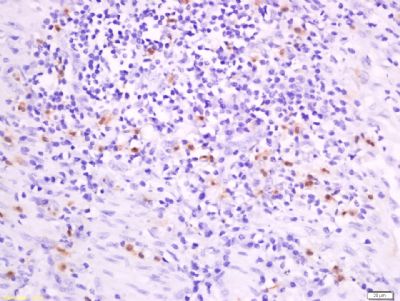 Tissue/cell: human rectal cancer; 4% Paraformaldehyde-fixed and paraffin-embedded; Antigen retrieval: citrate buffer ( 0.01M, pH 6.0 ), Boiling bathing for 15min; Block endogenous peroxidase by 3% Hydrogen peroxide for 30min; Blocking buffer (normal goat serum,C-0005) at 37℃ for 20 min; Incubation: Anti-IP3 receptor Polyclonal Antibody, Unconjugated(bs-8869R) 1:200, overnight at 4°C, followed by conjugation to the secondary antibody(SP-0023) and DAB(C-0010) staining |








