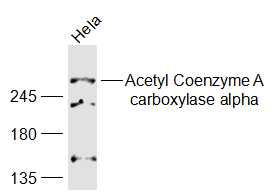
产品货号: jlcR11912 英文名称 : Acetyl Coenzyme A carboxylase alpha 中文名称 : 乙酰辅酶A羧化酶1/ACCα抗体 别名 : ACAC; ACACA; ACACA; ACACA_HUMAN; ACC alpha; ACC-alpha; ACC1; ACC1; ACCA; Acetyl Coenzyme A; Biotin carboxylase; ACACA_MOUSE; Acetyl Coenzyme A carboxylase alpha; ACACA_RAT; Acetyl-CoA carboxylase 1; ACC-alpha. 研究领域 :肿瘤细胞生物信号转导转录调节因子激酶和磷酸酶新陈代谢 抗体来源: Rabbit 克隆类型 : Polyclonal 交叉反应 : Human, Mouse, Rat, Dog, Pig, Cow, Horse, Rabbit, Sheep, 产品应用 : WB=1:500-2000 IHC-P=1:400-800 IHC-F=1:400-800 ICC=1:100-500 IF=1:100-500 (石蜡切片需做抗原修复) not yet tested in other applications. optimal dilutions/concentrations should be determined by the end user. 分子量: 266kDa 细胞定位 : 细胞浆 性状 : Lyophilized or Liquid 浓度 : 1mg/ml 免疫原 : KLH conjugated synthetic peptide derived from human ACACA:951-1050/2346 亚型: IgG 纯化方法 : affinity purified by Protein A 储存液 : 0.01M TBS(pH7.4) with 1% BSA, 0.03% Proclin300 and 50% Glycerol. 保存条件: Store at -20 °C for one year. Avoid repeated freeze/thaw cycles. The lyophilized antibody is stable at room temperature for at least one month and for greater than a year when kept at -20°C. When reconstituted in sterile pH 7.4 0.01M PBS or diluent of antibody the antibody is stable for at least two weeks at 2-4 °C. PubMed : PubMed 产品介绍 : Acetyl-CoA carboxylase (ACC) is a complex multifunctional enzyme system. ACC is a biotin-containing enzyme which catalyzes the carboxylation of acetyl-CoA to malonyl-CoA, the rate-limiting step in fatty acid synthesis. There are two ACC forms, alpha and beta, encoded by two different genes. ACC-alpha is highly enriched in lipogenic tissues. The enzyme is under long term control at the transcriptional and translational levels and under short term regulation by the phosphorylation/dephosphorylation of targeted serine residues and by allosteric transformation by citrate or palmitoyl-CoA. Multiple alternatively spliced transcript variants divergent in the 5' sequence and encoding distinct isoforms have been found for this gene. [provided by RefSeq, Jul 2008]
Function: Catalyzes the rate-limiting reaction in the biogenesis of long-chain fatty acids. Carries out three functions: biotin carboxyl carrier protein, biotin carboxylase and carboxyltransferase.
Subunit: Monomer, homodimer, and homotetramer. Can form filamentous polymers. Interacts in its inactive phosphorylated form with the BRCT domains of BRCA1 which prevents ACACA dephosphorylation and inhibits lipid synthesis. Interacts with MID1IP1; interaction with MID1IP1 promotes oligomerization and increases its activity.
Subcellular Location: Cytoplasm.
Tissue Specificity: Expressed in brain, placental, skeletal muscle, renal, pancreatic and adipose tissues; expressed at low level in pulmonary tissue; not detected in the liver.
Post-translational modifications: Phosphorylation on Ser-1263 is required for interaction with BRCA1.
DISEASE: Defects in ACACA are a cause of acetyl-CoA carboxylase 1 deficiency (ACACAD) [MIM:200350]; also known as ACAC deficiency or ACC deficiency. An inborn error of de novo fatty acid synthesis associated with severe brain damage, persistent myopathy and poor growth.