| 供应商 | 上海康朗生物科技有限公司 |
| 数量 | 大量 |
| 目录编号 | kl-1677R |
| 克隆性 | 多克隆 |
| 抗原来源 | Rabbit |
| 保质期 | 12个月 |
| 抗体英文名 | DNA Ligase IV antibody |
| 抗体名 | DNA连接酶4抗体 |
| 宿主 | Rabbit |
| 适应物种 | Human, Mouse, Rat, Chicken, Dog, Cow, Horse, Rabbit, Sheep, |
| 免疫原 | KLH conjugated synthetic peptide derived from human DNA Ligase IV:51-150/911 |
| 亚型 | IgG |
| 形态 | 冻干粉或液体 |
| 应用范围 | WB=1:500-2000 ELISA=1:500-1000 IHC-P=1:400-800 IHC-F=1:400-800 ICC=1:100-500 IF=1:100-500 |
| 浓度 | 1mg/ml |
| 保存条件 | -20 °C |
| 规格 | 100ul 200ul |
| 中文名称 | DNA连接酶4抗体 |
| 别 名 | LIG4; DNA ligase IV ATP dependent; DNA ligase IV ATP dependent; DNA joinase; DNA joinase; DNA ligase 4; DNA ligase IV; DNA repair enzyme; DNA repair enzyme; DNLI4_HUMAN; LIG 4; LIG4; LIG-4; Ligase IV; Ligase IV; Ligase IV DNA ATP dependent; Polydeoxyribonucleotide synthase [ATP] 4; Polydeoxyribonucleotide synthase 4; Polydeoxyribonucleotide synthase; Polydeoxyribonucleotide synthase; Polynucleotide ligase; Polynucleotide ligase; Sealase. |
| 规格价格 | 100ul/1380元 购买 200ul/2200元 购买 大包装/询价 |
| 说 明 书 | 100ul 200ul |
| 研究领域 | 细胞生物 表观遗传学 |
| 抗体来源 | Rabbit |
| 克隆类型 | Polyclonal |
| 交叉反应 | Human, Mouse, Rat, Chicken, Dog, Cow, Horse, Rabbit, Sheep, |
| 产品应用 | WB=1:500-2000 ELISA=1:500-1000 IHC-P=1:400-800 IHC-F=1:400-800 ICC=1:100-500 IF=1:100-500 (石蜡切片需做抗原修复) not yet tested in other applications. optimal dilutions/concentrations should be determined by the end user. |
| 分 子 量 | 104kDa |
| 性 状 | Lyophilized or Liquid |
| 浓 度 | 1mg/ml |
| 免 疫 原 | KLH conjugated synthetic peptide derived from human DNA Ligase IV:51-150/911 |
| 亚 型 | IgG |
| 纯化方法 | affinity purified by Protein A |
| 储 存 液 | 0.01M TBS(pH7.4) with 1% BSA, 0.03% Proclin300 and 50% Glycerol. |
| 保存条件 | Store at -20 °C for one year. Avoid repeated freeze/thaw cycles. The lyophilized antibody is stable at room temperature for at least one month and for greater than a year when kept at -20°C. When reconstituted in sterile pH 7.4 0.01M PBS or diluent of antibody the antibody is stable for at least two weeks at 2-4 °C. |
| PubMed | PubMed |
| 产品介绍 | background: The X-ray repair cross-complementing protein XRCC4 and DNA Ligase IV are essential for repairing double-strand breaks in DNA. These proteins form a critical complex consisting of two molecules of each protein that preferentially bind DNA with nicks or broken ends. As an obligate accessory molecule, XRCC4 binds to DNA Ligase IV and enhances its joining activity. The XRCC4/ DNA Ligase IV complex is also involved in V(D)J recombination. V(D)J recombination occurs in normal development of the adaptive immune system and involves the formation of a double-strand break intermediate. Deletions of either DNA Ligase IV or XRCC4 inhibit the completion of V(D)J recombination, resulting in a high incidence of apoptosis in the developing nervous system and a block in B and T cell maturation. Function: Efficiently joins single-strand breaks in a double-stranded polydeoxynucleotide in an ATP-dependent reaction. Involved in DNA non-homologous end joining (NHEJ) required for double-strand break repair and V(D)J recombination. The LIG4-XRCC4 complex is responsible for the NHEJ ligation step, and XRCC4 enhances the joining activity of LIG4. Binding of the LIG4-XRCC4 complex to DNA ends is dependent on the assembly of the DNA-dependent protein kinase complex DNA-PK to these DNA ends. Tissue Specificity: Testis, thymus, prostate and heart. DISEASE: Defects in LIG4 are the cause of LIG4 syndrome (LIG4S) [MIM:606593]. This disease is characterized by immunodeficiency and developmental and growth delay. Patients display unusual facial features, microcephaly, growth and/or developmental delay, pancytopenia, and various skin abnormalities. Defects in LIG4 are a cause of severe combined immunodeficiency autosomal recessive T-cell-negative/B-cell-negative/NK-cell-positive with sensitivity to ionizing radiation (RSSCID) [MIM:602450]. SCID refers to a genetically and clinically heterogeneous group of rare congenital disorders characterized by impairment of both humoral and cell-mediated immunity, leukopenia, and low or absent antibody levels. Patients with SCID present in infancy with recurrent, persistent infections by opportunistic organisms. The common characteristic of all types of SCID is absence of T-cell-mediated cellular immunity due to a defect in T-cell development. Individuals affected by RS-SCID show defects in the DNA repair machinery necessary for coding joint formation and the completion of V(D)J recombination. A subset of cells from such patients show increased radiosensitivity. Similarity: Belongs to the ATP-dependent DNA ligase family. Contains 2 BRCT domains. SWISS: P49917 Gene ID: 3981 Database links: Entrez Gene: 3981 Human Entrez Gene: 319583 Mouse Entrez Gene: 100173511 Orangutan Omim: 601837 Human SwissProt: P49917 Human SwissProt: Q8BTF7 Mouse SwissProt: Q5R6L3 Orangutan Unigene: 166091 Human Unigene: 80584 Mouse Important Note: This product as supplied is intended for research use only, not for use in human, therapeutic or diagnostic applications. |
| 产品图片 | 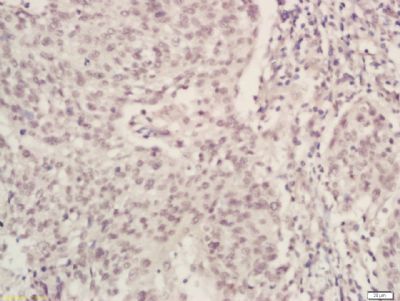 Tissue/cell: human laryngocarcinoma; 4% Paraformaldehyde-fixed and paraffin-embedded; Antigen retrieval: citrate buffer ( 0.01M, pH 6.0 ), Boiling bathing for 15min; Block endogenous peroxidase by 3% Hydrogen peroxide for 30min; Blocking buffer (normal goat serum,C-0005) at 37℃ for 20 min; Incubation: Anti-LIG4 Polyclonal Antibody, Unconjugated(bs-1677R) 1:200, overnight at 4°C, followed by conjugation to the secondary antibody(SP-0023) and DAB(C-0010) staining |





