| 供应商 | 上海联迈生物工程有限公司 |
| 数量 | 大量 |
| 目录编号 | LM-19994R |
| 克隆性 | 多克隆 |
| 抗原来源 | Rabbit |
| 保质期 | 1年 |
| 抗体英文名 | PABP2 |
| 抗体名 | 多聚腺苷酸结合蛋白2抗体 |
| 宿主 | Rabbit |
| 适应物种 | Human, Mouse, Dog, Cow, Horse, Rabbit, Sheep, |
| 免疫原 | KLH conjugated synthetic peptide derived from human PABP2:181-280/306 |
| 亚型 | IgG |
| 形态 | Lyophilized or Liquid |
| 应用范围 | WB=1:500-2000 ELISA=1:500-1000 IHC-P=1:400-800 IHC-F=1:400-800 ICC=1:100-500 IF=1:100-500 (石蜡切片需做抗原修复) |
| 浓度 | 1mg/ml |
| 保存条件 | Store at -20 °C |
| 规格 | 100ul 200ul |
| 英文名称 | PABP2 |
| 中文名称 | 多聚腺苷酸结合蛋白2抗体 |
| 别 名 | Nuclear poly(A) binding protein 1; PAB2; PABII; PABP2; PABPN1; Poly(A) binding protein 2; Polyadenylate binding nuclear protein 1; Polyadenylate binding protein 2; ROX2. |
| 规格价格 | 100ul/1380元 购买 200ul/2200元 购买 大包装/询价 |
| 说 明 书 | 100ul 200ul |
| 研究领域 | 细胞生物 信号转导 结合蛋白 表观遗传学 |
| 抗体来源 | Rabbit |
| 克隆类型 | Polyclonal |
| 交叉反应 | Human, Mouse, Dog, Cow, Horse, Rabbit, Sheep, |
| 产品应用 | WB=1:500-2000 ELISA=1:500-1000 IHC-P=1:400-800 IHC-F=1:400-800 ICC=1:100-500 IF=1:100-500 (石蜡切片需做抗原修复) not yet tested in other applications. optimal dilutions/concentrations should be determined by the end user. |
| 分 子 量 | 33kDa |
| 细胞定位 | 细胞核 细胞浆 |
| 性 状 | Lyophilized or Liquid |
| 浓 度 | 1mg/ml |
| 免 疫 原 | KLH conjugated synthetic peptide derived from human PABP2:181-280/306 |
| 亚 型 | IgG |
| 纯化方法 | affinity purified by Protein A |
| 储 存 液 | 0.01M TBS(pH7.4) with 1% BSA, 0.03% Proclin300 and 50% Glycerol. |
| 保存条件 | Store at -20 °C for one year. Avoid repeated freeze/thaw cycles. The lyophilized antibody is stable at room temperature for at least one month and for greater than a year when kept at -20°C. When reconstituted in sterile pH 7.4 0.01M PBS or diluent of antibody the antibody is stable for at least two weeks at 2-4 °C. |
| PubMed | PubMed |
| 产品介绍 | background: This gene encodes an abundant nuclear protein that binds with high affinity to nascent poly(A) tails. The protein is required for progressive and efficient polymerization of poly(A) tails at the 3' ends of eukaryotic transcripts and controls the size of the poly(A) tail to about 250 nt. At steady-state, this protein is localized in the nucleus whereas a different poly(A) binding protein is localized in the cytoplasm. This gene contains a GCG trinucleotide repeat at the 5' end of the coding region, and expansion of this repeat from the normal 6 copies to 8-13 copies leads to autosomal dominant oculopharyngeal muscular dystrophy (OPMD) disease. Related pseudogenes have been identified on chromosomes 19 and X. Read-through transcription also exists between this gene and the neighboring upstream BCL2-like 2 (BCL2L2) gene. [provided by RefSeq, Dec 2010] Function: Involved in the 3'-end formation of mRNA precursors (pre-mRNA) by the addition of a poly(A) tail of 200-250 nt to the upstream cleavage product. Stimulates poly(A) polymerase (PAPOLA) conferring processivity on the poly(A) tail elongation reaction and controls also the poly(A) tail length. Increases the affinity of poly(A) polymerase for RNA. Is also present at various stages of mRNA metabolism including nucleocytoplasmic trafficking and nonsense-mediated decay (NMD) of mRNA. Cooperates with SKIP to synergistically activate E-box-mediated transcription through MYOD1 and may regulate the expression of muscle-specific genes. Binds to poly(A) and to poly(G) with high affinity. May protect the poly(A) tail from degradation (By similarity). Subunit: May interact with SETX (PubMed:21700224). Monomer and homooligomer. Binds RNA as a monomer and oligomerizes when bound to poly(A). Interacts with PAPOLA, but only in presence of oligo(A) RNA. Interacts with transportin. Identified in a IGF2BP1-dependent mRNP granule complex containing untranslated mRNAs. Association in a ternary complex with CPSF4 and influenza A virus NS1 blocks pre-mRNAs processing, thereby preventing nuclear export of host cell mRNAs. Associates in a single complex with SKIP and MYOD1 and interacts with SKIP in differentiated myocytes. Interacts with NUDT21/CPSF5. Subcellular Location: Cytoplasmic and Nuclear. Tissue Specificity: Ubiquitous. Post-translational modifications: Arginine dimethylation is asymmetric and involves PRMT1 and PRMT3. It does not influence the RNA binding properties (By similarity). DISEASE: The disease is caused by mutations affecting the gene represented in this entry. Disease description:A form of late-onset slowly progressive myopathy characterized by eyelid ptosis, dysphagia and, sometimes by other cranial and limb-muscle involvement. Similarity: Contains 1 RRM (RNA recognition motif) domain. SWISS: Q86U42 Gene ID: 8106 Database links: Entrez Gene: 8106 Human Entrez Gene: 18459 Mouse Omim: 602279 Human SwissProt: Q86U42 Human SwissProt: Q8CCS6 Mouse Important Note: This product as supplied is intended for research use only, not for use in human, therapeutic or diagnostic applications. |
| 产品图片 | 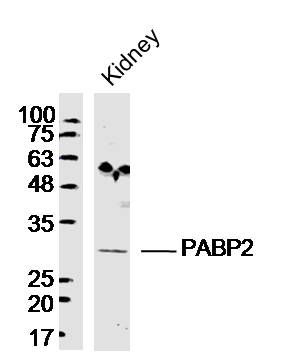 Sample:Kidney (Mouse)Lysate at 40 ug Primary: Anti-PABP2(bs-19994R)at 1/300 dilution Secondary: IRDye800CW Goat Anti-RabbitIgG at 1/20000 dilution Predicted band size: 33kD Observed band size: 33kD  Paraformaldehyde-fixed, paraffin embedded (Mouse brain); Antigen retrieval by boiling in sodium citrate buffer (pH6.0) for 15min; Block endogenous peroxidase by 3% hydrogen peroxide for 20 minutes; Blocking buffer (normal goat serum) at 37°C for 30min; Antibody incubation with (PABP2) Polyclonal Antibody, Unconjugated (bs-19994R) at 1:400 overnight at 4°C, followed by operating according to SP Kit(Rabbit) (sp-0023) instructions and DAB staining. |





