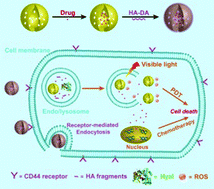
As a novel technique, photochemical internalization (PCI) has been employed as a new approach to overcome endo/lysosomal restriction, which is one of the main difficulties in both drug and gene delivery. However, the complicated synthesis procedure (usually requiring the self-assembly of polymers, photosensitizers and cargos) and payload specificity greatly limit its further application. In this paper, we employ a highly fluorescent graphitic hollow carbon nitride nanosphere (GHCNS) to simultaneously serve as a PCI photosensitizer, an imaging agent and a drug carrier. The surface modification of GHCNS with multifunctional polysaccharide hyaluronic acid (HA) endows the system with colloidal stability, biocompatibility and cancer cell targeting ability. After CD44 receptor-mediated endocytosis, the nanosystem is embedded in endo/lysosomal vesicles and HA could be specially degraded by hyaluronidase (Hyal), inducing open pores. In the following, with visible light illumination, GHCNS could produce ROS that effectively induced lipid peroxidation and caused endo/lysosomal membrane break, accelerating the cytoplasmic release of the drug in the targeted and irradiated cells. As a result, significantly increased therapeutic potency and specificity against cancer cells could be achieved.