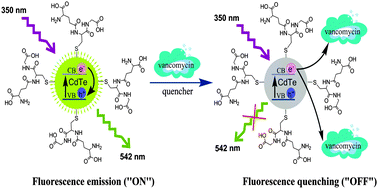
A simple and sensitive fluorescence “turn-off” biosensor for detection of vancomycin at nanogram level was proposed based on the electron transfer mechanism and the fluorescence quenching of CdTe quantum dots (QDs). The electron transfer process during the interaction between vancomycin and GSH (glutathione)-CdTe QDs was investigated not only by ultraviolet/visible (UV/vis) absorption and fluorescence (FL) spectroscopy but also by fluorescence lifetime measurements. The degree of the electron transfer and as resulted fluorescence quenching was proportional to the increasing of vancomycin concentration in the range of 1.534 ng mL−1–20 μg mL−1, with a corresponding detection limit of 0.4605 ng mL−1. This proposed a biosensor that could be used to determine vancomycin in environmental water samples, pharmaceutical formulation and spiked human serum with all of the recoveries over 95.8%. The mechanism of the detection was dynamic quenching with an electron transfer (ET) process. The experimental conditions, key affecting factors and the influence of the coexisting substances have also been optimized and studied.