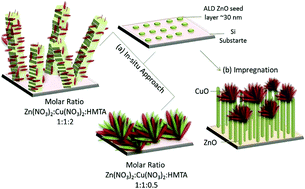
This study reports a cost-effective approach for the fabrication of CuO–ZnO nanocomposites with different morphological features via in situ and impregnation approaches of a controlled amount of copper to obtain optimum photocatalytic activity. The impregnation approach results in flower, sheet and coral-shaped CuO particles in junction with ZnO nanowires (NWs). On the other hand, the transformation of ZnO NWs to flower-like (very rough) and pillar-like CuO–ZnO nanostructures with CuO outgrowths has been observed with an in situ approach as a function of molar ratio [(CuNO3 : ZnNO3)]: hexamethylenetetrammine of 2 > 1 > 0.5 > 0.25. CuO–ZnO nanocomposites exhibited a slight red-shift in their band-gap values (3.2 to 2.8 eV) when increasing the copper content during the in situ approach. An increase (∼2 fold) in the photocatalytic efficiency for the degradation of methyl orange has been noticed with in situ grown CuO–ZnO composites on an Si substrate as compared to pristine ZnO NWs. The apparent rate constant (k) was found to be the highest for in situ fabricated CuO–ZnO nanocomposites (1.5 × 10⁻¹ h−1) as compared to 2.6 × 10⁻² h−1 for impregnated Cu1:Zn1, and least (1.8 × 10⁻² h−1) for pristine ZnO NWs during methyl orange photooxidation. CuO–ZnO nanocomposites with rough exposed surface and CuO outgrowths provide a high active surface area and stable p–n junctioned interfacial contact for application in environmental purification.