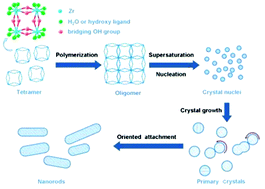
ZrO2 nanorods with different dispersibility were prepared via a facile microwave-hydrothermal approach in the absence of any organic modifier. XRD, TEM, HRTEM, N2 adsorption窶電esorption measurements (BET) and XPS were used to characterize the microstructure of as-prepared ZrO2 nanorods, and a possible mechanism was proposed to explain the formation and evolution of ZrO2 nanorods under microwave irradiation. The concentration of zirconium precursor was found to significantly affect the dispersion of ZrO2 nanorods, and the lower concentration of zirconium precursor favors the formation of ZrO2 nanorods with higher dispersibility under microwave irradiation. The as-prepared ZrO2 nanorods were further used to estimate their potential application as a humidity sensor. The sample with a higher concentration of surface oxygen vacancies exhibits a higher humidity sensor response due to more active sites for water adsorption, and the humidity sensing mechanism of ZrO2 nanorods was also discussed by complex impedance spectra in detail.