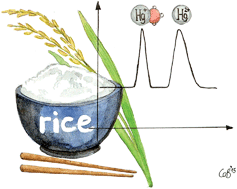
Recent studies of methylmercury (MeHg) in rice have shown that rice grown on mercury contaminated soil contributes to the human MeHg intake similar to a fish diet. Trace levels of MeHg in biological samples are often determined via a complex multi-stage process following EPA method 1630. We developed a simple and cost effective method suited for food quality monitoring based on a simple sample preparation procedure and the subsequent analysis of the sample with online preconcentration via solid phase extraction high performance liquid chromatography cold vapor atomic fluorescence spectrometry (SPE-HPLC-CV-AFS). The reliability of this method for MeHg in rice and rice products in the low ppb range was investigated for 4 different rice product samples. At present, no CRM for MeHg in rice or rice products is available. Therefore we cross-validated our method against standard addition and species-specific isotope dilution gas chromatography inductively coupled plasma mass spectrometry (SSID-GC-ICPMS), which showed no significant difference versus the external calibration with SPE-HPLC-CV-AFS. Potential species interconversion during sample preparation and measurement was ruled out by using a spike of isotopically enriched inorganic mercury. The SPE-HPLC-CV-AFS developed in our work has proven to be a robust, fast, cost efficient, competitive and reliable method for MeHg speciation in rice and rice products with a limit of detection of 0.12 µg kg−1 and a reproducibility comparable to the SS-ID-GC-ICPMS method which is sufficient for the determination of MeHg in the four market rice samples. The concentrations of MeHg ranged from 1.6 to 2.7 µg kg−1.