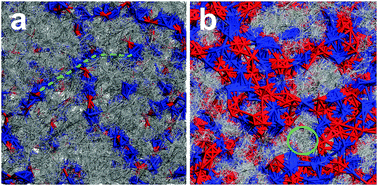
We investigated the mutual solubility of mixtures of phosphonium-based ionic liquids with alkanes, alkanols, fluorinated alkanes and fluorinated alkanols. The solubilities of other solute molecules like water, formamide, 1,4-dioxane, benzene, and dimethylsulfoxide were also tested. Whenever possible, the corresponding temperature-composition (T-x) phase diagrams at atmospheric pressure were built from cloud-point temperature determinations. The influence of the size of the solute was tested with binary mixtures of trihexyl(tetradecyl)phosphonium acetate, [P6 6 6 14][Ac], with hexane, decane or tetradecane. The influence of the anion of the ionic liquid, namely acetate, [Ac], bis-[(trifluoromethyl)sulfonyl]imide, [Ntf2], trifluoromethanesulfonate, [Otf], and dicyanamide, [dca], on the solubility of the ionic liquids in hexane was also studied. For the ionic liquid [P6 6 6 14][Ntf2] the liquid–liquid phase diagrams were determined with different solutes—alkanes, perfluoroalkanes, partially fluorinated alkanes, and partially fluorinated alkanols—with the aim of analysing the solute–solvent interactions. A comparison of the phase behaviour of solutions containing phosphonium-based ionic liquids and 1-alkyl-3-methylimidazolium based ionic liquids, including a discussion of their different morphologies at a structural level, is also provided. It was found that fluorination of the aliphatic chains of organic compounds can be used as an effective way to control the solubility limits of these compounds in phosphonium- or imidazolium-based ionic liquids, both in terms of concentration and temperature.