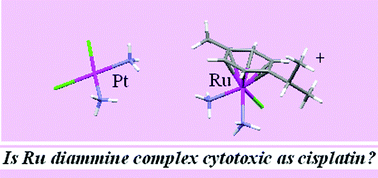
The light-protected reaction of [(η6-p-cymene)RuIICl2]2 with 1-(2-hydroxyethyl)piperazine in dry methanol, followed by addition of excess NH4PF6, afforded the complex [(η6-p-cymene)RuII(NH3)2Cl](PF6) (1) in 47% yield. Attempts to use the same protocol for the synthesis of [(η6-p-cymene)OsII(NH3)2Cl](PF6) led to the isolation of the binuclear triply methoxido-bridged arene-osmium compound [{(η6-p-cymene)Os}2(μ-OCH3)3](PF6) (3). Both compounds were characterised by X-ray crystallography and 1H NMR spectroscopy, and the ruthenium complex also by spectroscopic techniques (IR and UV-vis spectroscopies). The antiproliferative activity of complex 1in vitro was studied in A549 (non-small cell lung carcinoma), CH1 (ovarian carcinoma), and SW480 (colon carcinoma) cells and compared to that of [(η6-p-cymene)RuII(en)Cl](PF6) (2). In contrast to the latter compound, 1 is only modestly cytotoxic in all three cell lines (IC50: 293–542 μM), probably due to the instability of the diammine ruthenium complex in aqueous solution.