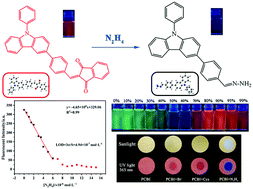
In this work, based on the N-phenyl carbazole fluorescent group, a new molecule named 2-(4-(9-phenyl-9H-carbazol-3-yl)benzylidene)-1H-indene-1,3(2H)-dione (PCBI) is firstly synthesized and used as a fluorescent probe for detecting N2H4 in aqueous solutions. The PCBI probe exhibits an excellent aggregation-induced emission (AIE) effect with a good fluorescence response to N2H4 in a DMF–H2O (fw = 90%) system. A fitting curve between the fluorescence intensity at 628 nm of probe and the concentration of N2H4 shows excellent linear in the range of 0–6 × 10⁻⁶ mol L−1. Meanwhile, the PCBI probe exhibits good sensitivity and selectivity. Based on the density functional theory, the sensing mechanism of this probe is attributed to a change of the molecular aggregation state and an induced charge transfer (ICT) effect from group conversion. The PCBI test strip can be applied successfully to detect N2H4 rapidly in water.