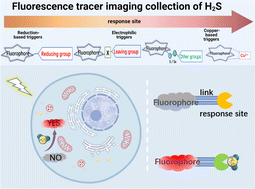
H2S, the smallest and simplest biological thiol in living systems, is the third member of the family of signaling mediators. H2S participates in the regulation of a series of complex physiological and pathological functions in the body, making it a critical fulcrum that balances health and disease in human physiology. Small-molecule fluorescent probes have been proven to possess the unique advantages of high temporal and spatial resolution, good biocompatibility and high sensitivity, and thus their use is a powerful approach for monitoring the level and dynamics of H2S in living cells and organisms and better understanding its basic cellular functions. The field of small-molecule fluorescent probes for monitoring the complex biological activities of H2S in vivo has been thriving in recent years. Herein, we systematically summarize the latest developments in the field of fluorescent probes for the detection of H2S, illustrate their biological applications according to the classification of target-responsive sites, and emphasize the development direction and challenges of H2S-responsive fluorescent probes, hoping to give implications of researchers on fluorescent probes for future research.