In wastewater treatment plants (WWTPs), external carbon sources are often required due to low C/N influent. However, the use of external carbon sources can increase treatment costs and cause large carbon emissions. Beer wastewater, which contains a substantial amount of carbon, is often treated separately in China, consuming significant energy and cost. However, most studies using beer wastewater as an external carbon source are still on a laboratory scale. To address this issue, this study proposes using beer wastewater as an external carbon source in an actual WWTP to reduce operating costs and carbon emissions while achieving a win–win situation. The denitrification rate of beer wastewater was found to be higher 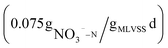 than that of sodium acetate
 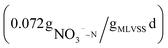 , resulting in improved treatment efficiency of the WWTP. Specifically, COD, BOD5, TN, NH4+–N and TP increased by 3.4%, 1.6%, 10.8%, 1.1%, and 1.7%, respectively. Additionally, the treatment cost and carbon emission per 10 000 tons of wastewater treated were reduced by 537.31 yuan and 2.27 t CO2, respectively. These results indicate that beer wastewater has significant utilization potential and provide a reference for using different types of production wastewater in WWTPs. This study's findings demonstrate the feasibility of implementing this approach in an actual WWTP setting.















