We report the preparation, spectroscopic characterisation, crystal structure determination and cryomagnetic investigation of three cobalt(II) complexes of formula trans-[Co(bim)4(NCS)2] (1), [Co(bim)2(NCO)2] (2) and [Co(bim)2(N3)2]n (3) (bim = 1-benzylimidazole). The structure of 1 is made up of neutral [Co(bim)4(NCS)2] mononuclear units, where the cobalt(II) ion is six-coordinate with four monodentate bim ligands in equatorial positions and two N-thiocyanato groups in the axial sites building a slightly compressed octahedron. In contrast to 1, each cobalt(II) ion in 2 is four-coordinate with two imidazole-nitrogen atoms from two bim molecules and two N-cyanato ligands describing a slightly distorted tetrahedral geometry, the value of Okuniewski's structural parameter being 0.925. The structure of 3 consists of uniform chains of cobalt(II) ions connected by double end-to-end azido bridges in equatorial positions with two trans-coordinated bim molecules occupying the axial sites. The Co–Nbim bond lengths in 3 are ca. 0.06 Å shorter than the Co–Nazido distances, the value of the tetragonality parameter being 1.03. The intrachain cobalt–cobalt separation is 5.361(1) Å, a value which is much shorter than the shortest interchain one (ca. 12.4 Å). Detailed solid state ac and dc magnetic studies show that 1 and 2 are field-induced single-ion magnets with D = +88.6 (1) and −6.8 cm−1 (2). Q-band EPR spectrometry measurements for polycrystalline samples of 1 and 2 confirm the signs of D and reveal the occurrence of a strong (1)/low (2) low asymmetry in the g-tensors. Theoretical calculations by CASSCF/NEVPT2 support the results from magnetometry and EPR for 1 and 2. The values of the spin reversal barrier which were obtained from the corresponding Arrhenius plots cover the ranges 48.0–50.2 cm−1 (1) and 25.9–27.2 and 11.5–13.1 cm−1 for the high- and low-temperature relaxation processes (2). Compound 3 exhibits an overall antiferromagnetic behaviour with a maximum of the magnetic susceptibility at ca. 70 K, the intrachain antiferromagnetic coupling being J = −26.5 cm−1 (the spin Hamiltonian being defined as 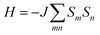 ). This value is of the same nature and its size compares well with those reported for the scarce examples of this type of cobalt(II) chain.














