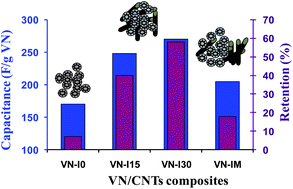
Nanostructured vanadium nitride/multiwalled carbon nanotubes (VN/CNTs) composites for pseudo-capacitor applications were obtained via the sol–gel synthesis of organic or inorganic vanadium oxide precursors followed by temperature programmed ammonia reduction. Nitrogen adsorption and impedance spectroscopy measurements showed that the incorporation of CNTs during VN synthesis allows VN/CNTs nanocomposites to be obtained with higher porosity, narrower pore size distribution, better conductivity and improved electrochemical properties compared to VN without CNTs. In particular, cyclic voltammetry using three-electrode cells in KOH shows that the contribution of the redox peaks is increased when VN is associated with the carbon nanotubes. As a consequence, a capacitance increase was measured in the two-electrode system. Another important advantage of using VN/CNTs composites is their high capacitance retention (58%) at high current density (30 A g−1) compared with VN (7%), resulting in an enhancement of the energy density at high power. All these positive aspects were significantly more marked when CNTs were incorporated during VN synthesis compared to a material resulting from the physical mixture of VN with CNTs. TEM, XPS and Raman analyses point out that the enhanced electrochemical performance observed with the VN/CNTs composite could be related to an intimate contact between VN and the CNT network, a homogeneous distribution of VN on CNTs and the presence of an open mesoporous texture favouring the access of the electrolyte to the active material surface.