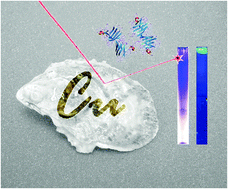
The pacific oyster (Crassostrea gigas), a good model for studying biomineralization and coastal environmental change, was used to study the expression of cuproproteins after waterborne Cu exposure (3 μg Cu L−1) similarly to the Arcachon Bay aquatic environment. Cuproproteins in oyster cytosols were analyzed by gel electrophoresis (non-denaturing PAGE and SDS 2-DE), laser ablation inductively coupled plasma mass spectrometry (LA-ICP MS) and electrospray ionization mass spectrometry (ESI-MS). The high molecular weight cuproproteins (identified as extracellular superoxide dismutase [Cu–Zn] (EC Cu/Zn-SOD) and L-ascorbate oxidase) in digestive glands of oysters were differentially expressed after Cu exposure. About 1.7 and 1.2-fold increase of the Cu level in EC Cu/Zn-SOD and L-ascorbate oxidase were, respectively, determined, although EC Cu/Zn-SOD was 1.6–1.9-fold down-regulated in the digestive gland of oysters after Cu exposure. At last, the role of EC Cu/Zn-SOD in protection against Cu exposure was discussed to propose possible mechanisms to better understand Cu homeostasis and/or detoxification mechanisms.