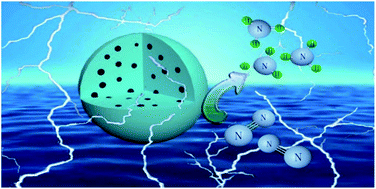
Developing high-efficiency electrocatalysts for artificial nitrogen fixation at room temperature and atmospheric pressure is fundamentally important but challenging. Herein, MoFe-PC (PC, phosphorus-doped carbon) microspheres, synthesized by facile one-step pyrolysis–phosphating of bimetallic metal–organic framework (MOF) precursors, were used as a cost-efficient catalyst for the electrocatalytic nitrogen reduction reaction (NRR). With the advantageous characteristics of the multicomponent active sites and porous structure inherited from the MOF precursor, the MoFe-PC catalyst achieves a peak NH3 yield rate of 34.23 μg h−1 mgcat.−1 with a high faradaic efficiency (FE) of 16.83% at −0.5 V vs. a reversible hydrogen electrode (RHE) in 0.1 M HCl under ambient conditions, exceeding those of most of the previously reported noble metal- or non-noble metal-based NRR electrocatalysts under the same conditions. The changes of the surface composition and structure of the catalyst before and after NRR testing are monitored by ex situ XPS and XANES. The Mo and Fe oxides and PC in the hybrids are both active in the NRR, synergistically enhancing the NRR performance.