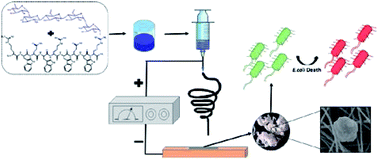
Electrospinning technology is useful for making ultrafine drug-eluting fibers for the clinical treatment of wounds. We show the incorporation of an antimicrobial LfcinB-derived peptide into Pullulan nanofibers. The palindromic peptide LfcinB (21–25)Pal: RWQWRWQWR was synthesized, purified, and characterized by means of the RP-HPLC and MALDI-TOF MS methods. The peptide's antibacterial activity against the E. coli ATCC 25922 strain was evaluated, and the peptide LfcinB (20–25)Pal exhibited significant antibacterial activity. Nanofibers were obtained by electrospinning a Pullulan or Pullulan-LfcinB (21–25)Pal solution. The obtained nanofibers were characterized via microscopy (AFM and SEM) and RP-HPLC chromatography. The peptide incorporation efficiency was 31%. The Pullulan-LfcinB (21–25)Pal nanofibers were soluble in water, and the peptide was liberated immediately. The Pullulan-LfcinB (21–25)Pal nanofibers exhibited the same antibacterial activity against E. coli strain as the free peptide LfcinB (21–25)Pal. The results suggest that Pullulan-LfcinB (21–25)Pal nanofibers could be considered for designing and developing antibacterial wound dressings.