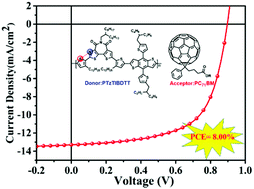
Two new wide bandgap copolymers PTzTIBDTT and PTzTIBDTT-S based on thiazolothienyl imide (TzTI) and benzodithiophene with a distinct side chain were synthesized and characterized for applications in polymer solar cells (PSCs). The single crystal of the TzTI model compound showed a highly planar backbone with a close π-stacking distance of 3.65 Å, a desired structural feature for efficient charge transport. Moreover, the TzTI incorporation can trigger intramolecular noncovalent N⋯S interactions to yield a self-planarized polymer backbone, which should be beneficial for achieving ordered molecular packing and efficient charge transport. Due to its strong electron-withdrawing effect, the incorporation of the TzTI unit largely lowers the polymer HOMO levels to −5.65 and −5.69 eV for PTzTIBDTT and PTzTIBDTT-S, respectively. The PSCs containing the PTzTIBDTT:PC71BM active layer exhibited a promising power conversion efficiency (PCE) of 8.00% with a large Voc of 0.90 V. To the best of our knowledge, the PCE is among the highest values for fullerene PSCs based on an imide-containing polymer donor. This work not only demonstrates that thiazolothienyl imide is a promising building block for constructing high-performance wide bandgap photovoltaic polymer semiconductors, but also reveals that a noncovalent N⋯S conformational lock is an effective molecular design approach for enabling polymer semiconductors with a planar backbone for efficient PSCs.